

By Jennifer Kryszak, Director of Strategic Planning for the Franciscan Peace Center
“This situation has to do not only with physics or biology, but also with the economy and the way we conceive it. The mentality of maximum gain at minimal cost, disguised in terms of reasonableness, progress and illusory promises, makes impossible any sincere concern for our common home and any real preoccupation about assisting the poor and the needy discarded by our society.” Francis, Laudate Deum, 31
The Supreme Court recently heard arguments in City of Grants Pass v. Johnson. This case was filed after Grants Pass passed city ordinances and then cited homeless people for sleeping in public. The plaintiffs argued that the city did not have beds for the homeless and, therefore, were punishing their existence. The district and appeals courts agreed with the plaintiffs, with the appeals court noting that it would be a violation of the Eighth Amendment if the city did not provide beds and then punished those with nowhere to sleep. According to Carol S. Steiker, the Henry J. Friendly Professor at Harvard Law School, it is unclear how the Supreme Court will decide the case. Steiker notes that the decision could have broader implications beyond criminalizing homelessness, including capital punishment, because of the reference to the Eighth Amendment.
What stands out to me about City of Grants Pass v. Johnson is the troubling reality that we as a society are still here. Homelessness has soared in the last few years. In “The 2023 Annual Homelessness Assessment Report (AHAR) to Congress,” the U.S. Department of Housing and Urban Development reported that about 653,100 people were experiencing homelessness and that homelessness had increased by 12% from 2022 to 2023 (HUD 2). While programs to address homelessness are proven to work, our communities often seek to eliminate homeless populations from their boundaries instead of working to eliminate the root causes of homelessness and serve those in need. As Pope Francis notes, this demonstrates our throwaway culture, the way in which we as a society discard those people and things that we perceive as not having value. How can another person not have value? How can we not be called to respond to the needs of others?
In Laudato Si’ and Laudate Deum, Pope Francis critiques the technocratic paradigm, which “consists in thinking ‘as if reality, goodness and truth automatically flow from technological and economic power as such’. As a logical consequence, it then becomes easy ‘to accept the idea of infinite or unlimited growth, which proves so attractive to economists, financiers and experts in technology” (Laudate Deum 20). Perceiving technological and economic power in this way stifles our ability to see value in others and creation apart from their utility. Francis asserts that this paradigm leads to the exploitation of people and the earth. Employing an example of a project that will affect the environment or include contamination, Francis notes that people are often not informed of the true impacts of a project: “Yet in reality there does not seem to be any true interest in the future of these people, since they are not clearly told that the project will result in the clearing of their lands, a decline in the quality of their lives, a desolate and less habitable landscape lacking in life, the joy of community and hope for the future; in addition to the global damage that eventually compromises many other people as well” (Laudate Deum 29). How can we move from this technocratic paradigm and the rejection of the value of the other to a place of encompassing care for all, including creation? For Francis, this conversion requires reassessing human power and relationships, including our relationship to the earth.
In Laudate Deum, Francis emphasizes the role of governments in responding to climate change and ensuring that vulnerable communities are protected. And yet, we know that governments need to be held accountable and reminded of their responsibility to the local and global community, including the earth. Thankfully there are diverse organizations dedicated to these efforts.
NETWORK is one such organization that seeks to educate and advocate for social justice. As their mission statement asserts, “Grounded in Gospel values and the Catholic social justice tradition, NETWORK transforms our society by shaping federal policies that achieve racial, economic, and social justice; serve the common good; and honor the dignity of all.” As a Catholic organization founded by women religious, NETWORK lobbies Congress to influence legislation as well as educates the public about issues and how to take action. Central to their current work is their Build Anew: A Justice Agenda for All of Us, which promotes a just and inclusive society. Issues they focus on include the budget, family-friendly workplace, food security, healthcare, housing, immigration, income, our criminal legal system, taxes, trade, and voting and democracy.
In the area of housing, NETWORK advocates for affordable housing, pathways to homeownership, and community and economic development in rural communities. From September to December 2023, Virginia Schilder wrote a series of weekly posts for the Build Anew Series. In the November 30 edition on Housing, Schilder notes the trend of increasing houselessness in the United States and the continuing realities of redlining and environmental racism in the housing market. As this reveals, environmental and social issues affecting our communities are not isolated realities but rather exist in complex webs of relationship and systems, such as the technocratic paradigm.
In order to value each person, we as a community need to take action to change systemic structures. While doing so certainly takes time and effort, we must remember that we do have ways of influencing our governments, especially through voting and lobbying. NETWORK and other organizations offer voting guides that note the complex connections between diverse environmental and social issues. As we move toward the November election, these guides can be beneficial reminders of the complex issues affecting our communities, nation, and world.
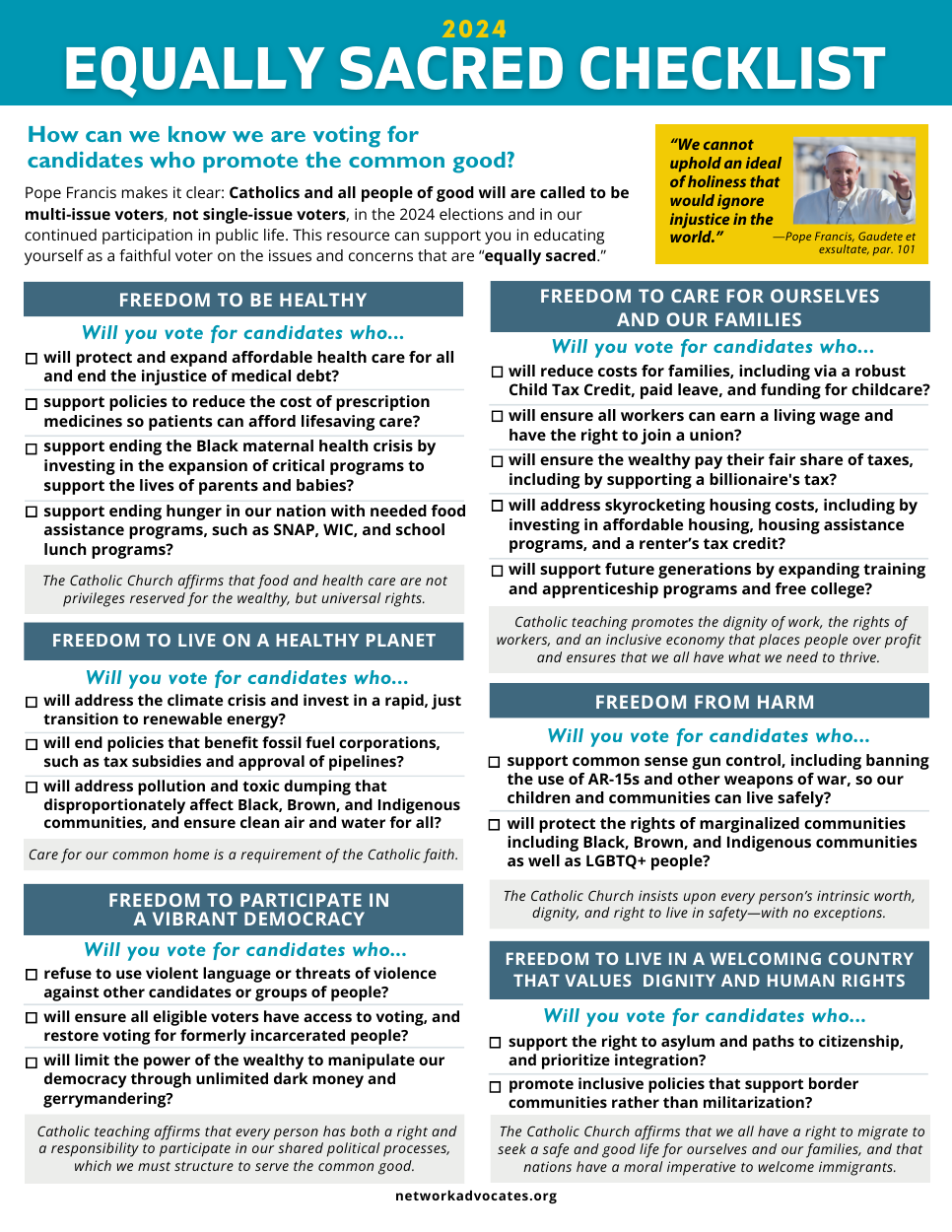
As we reflect today, let us consider the complexities of the communities we belong to. Who are the members of your community that you do not see or struggle to value? How can you influence your community to value all people and all of creation? How can you commit to holding our government accountable for the well-being of all people and creation?
Read more about NETWORK’s Build Anew: A Justice Agenda for All of Us to learn about the policies that they lobby on and the ways you can take action.
Take NETWORK’s Pope Francis Voter Pledge to commit to vote for candidates who uphold everyone’s freedom to be healthy, care for ourselves and our families, live on a healthy planet, participate in a vibrant democracy, live free from harm, and live in a welcoming country that values dignity and human rights.